
From the Sensex pack, Bajaj Finserv, Mahindra & Mahindra, Axis Bank, Bajaj Finance, Adani Ports, ICICI Bank, Zomato and UltraTech Cement were among the biggest gainers. However, ITC, Nestle, State Bank of India, Reliance Industries, Asian Paints and Tata Consultancy Services were among the laggards.

The Real Effective Exchange Rate (REER) of the rupee moderated in December to 107.20 after hitting a peak of 108.14 in November, latest data released by the Reserve Bank of India (RBI) showed. The REER was 103.66 in January 2024. The rupee depreciated around 3 per cent against the dollar in 2024.

Pakistan has halted the construction of contentious canals in Punjab province after India suspended the Indus Waters Treaty following a deadly terrorist attack in Kashmir. The decision to suspend the canals project was made after Prime Minister Shehbaz Sharif met with PPP chairman Bilawal Bhutto-Zardari and agreed to address the concerns of Sindh province, where the project had sparked protests. The canals project, aimed at irrigating the desert region in Punjab, was seen as a threat to water resources in Sindh. Both sides have agreed to seek consensus on the issue in the Council of Common Interests (CCI), a high-powered inter-provincial body. Meanwhile, Pakistan has reiterated the importance of the Indus Water Treaty for its water security and economy, and condemned India's move to suspend it.

The chief adviser's decision to stay in office came two days after he told student-led National Citizen Party (NCP) leaders that he was mulling resignation as he felt "the situation is such that he cannot work", citing difficulties in working amid the failure of political parties to find common ground for change.

US Vice President JD Vance called on India to drop non-tariff barriers, give greater access to its markets and buy more American energy products and military hardware. Vance, in a speech in Jaipur, highlighted the need for a stronger US-India partnership for a prosperous and peaceful 21st century. He emphasized the importance of working together to address global challenges and praised Prime Minister Narendra Modi, describing him as a "special person." Vance also urged India to provide greater market access to American products and buy more defense platforms and energy from the US. He suggested that India consider dropping some of the non-tariff barriers for American access to the Indian market and highlighted the benefits of closer India-US defense collaboration, advocating for New Delhi to procure more military hardware from the US. He cited the example of American fifth-generation F-35s, arguing they would give the Indian Air Force the ability to defend its airspace and protect its people like never before. Vance also welcomed the Modi government's budget announcement to amend India's civil nuclear liability laws, paving the way for US producers to export small modular reactors and build larger US-designed reactors in India. He emphasized the importance of energy security for India's AI ambitions, stating "there is no AI future without energy security and energy dominance." Vance's visit comes amid growing global concerns over the US's tariff war.

India's forex reserves dropped by $329 million to $578.45 billion for the week ended March 31, on decline in gold reserves, the RBI said on Friday. The forex kitty had risen handsomely in the previous two reporting weeks, and rose by $5.98 billion to $578.78 billion for the week ended March 24. For FY23, the overall kitty has dropped by $28.86 billion.

The US Trade Representative noted that India's average applied tariff rate stood at 17% per cent, the highest of any major world economy.

India's forex reserves increased by $6.31 billion to $584.76 billion for the week ended April 7, the RBI said on Friday. In the last reporting week, the forex kitty snapped a two-week rising trend to decline by $329 million to 578.45 billion. It can be noted that in October 2021, the country's forex kitty reached an all-time high of $645 billion.
India's forex reserves rose by $1.66 billion to $586.41 billion as of April 14, marking their second consecutive week of increase, according to the RBI data released on Friday. In the previous reporting week, the overall reserves rose by $6.31 billion to $584.76 billion. For the week ended April 14, the foreign currency assets, a major component of the reserves, increased by $2.20 billion to $516.64 billion, according to the Weekly Statistical Supplement released by the RBI.

India's stock markets corrected recently but foreign money is likely to chase China rather than India in the short-to-medium term, said Chris Wood, global head of equity strategy at Jefferies, on Thursday. Wood told the Business Standard Manthan Summit in New Delhi he is bullish about Indian equities from a long-term perspective, but for the short term he is cautious given the quantum of foreign investor (FII) outflows and valuation woes.

India's forex reserves dropped by $691 million to $562.808 billion as of December 23, making it the second consecutive week of decline in the kitty, according to the RBI data. The overall reserves had dropped by $571 million to $563.50 billion in the previous reporting week, snapping a five-week trend of an increase in the kitty. In October 2021, the country's foreign exchange reserves reached an all-time high of $645 billion.

The "construct of the DPDP Act" cannot be changed at this stage, though there may be some minor tweaks in the language of the Rules and formats in certain legitimate cases.

Union Road Transport and Highways Minister Nitin Gadkari on Wednesday pitched for formulating a policy for using the Reserve Bank of India's rising foreign exchange reserves for funding road projects, saying the country needs low cost finance for such infrastructure projects. Addressing a virtual event organised by industry body CII, Gadkari further said that the National Highways Authority of India (NHAI) should also have a financial arm like the power ministry's Power Finance Corporation (PFC). "We have a surplus of dollar reserves in the country. I have decided to talk with the RBI Governor, about how we can formulate a policy by which we can use this foreign exchange reserves for development of infrastructure in the country," he said.

India's economy is projected to grow between 6.3 per cent and 6.8 per cent in FY26, according to the Economic Survey 2024-25, tabled in Parliament on Friday. The survey highlights that the country's economic fundamentals remain strong, supported by a stable external account, fiscal consolidation, and private consumption. It noted that the government plans to strengthen long-term industrial growth by focusing on research and development (R&D), micro, small, and medium enterprises (MSMEs), and capital goods.

'If it doesn't, it will continue with measures to infuse liquidity, signalling a new cycle,' predicts Tamal Bandyopadhyay.

Shakti Dubey has topped the civil services examination 2024, with Harshita Goyal and Dongre Archit Parag getting the second and third ranks, the Union Public Service Commission (UPSC) announced on Tuesday. The top five successful candidates comprise three women and two men. The civil services examination is conducted annually in three stages -- preliminary, main and interview -- by the UPSC to select officers of the Indian Administrative Service (IAS), Indian Foreign Service (IFS) and Indian Police Service (IPS) among others. A total of 1,009 candidates -- 725 men and 284 women -- have been recommended by the UPSC for appointment to various services.

India's forex reserves jumped $5.25 billion to a new all-time high of $689.24 billion for the week ended September 6, the Reserve Bank of India said on Friday. The overall kitty had jumped by $2.3 billion to a record $683.99 billion for the previous reporting week.

India is among the top 10 nations in terms of foreign exchange reserves.

The rupee tumbled 3 per cent against the US dollar in 2024 as concerns over slower economic growth and a stronger greenback in global markets weighed, but it was among the least volatile currencies in the world and the headwinds may be less intense in the coming year.

The Reserve Bank of India (RBI) added another 102 metric tonnes to the domestically held gold in the April-September period, as per a disclosure made on Tuesday. The overall quantity of the precious metal stored in local safes stood at 510.46 metric tonnes as of September 30, which was up from over 408 metric tonnes as on March 31, 2024. The central bank said it added another 32 metric tonnes of gold reserves in the six-month period to take the overall tonnage to 854.73 metric tonnes, as per the half yearly report on management of foreign exchange reserves.

Amid liquidity tightness in the banking system, certificate of deposit (CD) rates topped 8 per cent for some smaller banks, with rates remaining on the higher side for derivatives loss-hit IndusInd Bank. On Thursday, CSB Bank raised Rs 100 crore via one-year CDs at 8.5 per cent, while Utkarsh Small Finance Bank issued three-month CDs at 8.05 per cent to raise Rs 50 crore.

Equity benchmark indices Sensex and Nifty rallied for the third session on the trot, helped by a rally in global markets after lower-than-expected consumer inflation in the US ignited hopes of more rate cuts by the Federal Reserve. The 30-share BSE index climbed 318.74 points or 0.42 per cent to revisit 77,000 level at 77,042.82.
The country's foreign exchange reserves declined by $3.01 billion to $561.05 billion in the week ended August 26, the Reserve Bank of India (RBI) data showed. In the previous week ended August 19, the reserves had dipped by $6.69 billion to $564.05 billion. The fall in the reserves during the reporting week ended August 26 was on account of a dip in the foreign currency assets (FCA), a major component of the overall reserves, and the gold reserves, according to the Weekly Statistical Supplement released by the RBI on Friday.
Forex reserves include a country's gold holdings and convertible foreign currencies held in its banks, including special drawing rights and exchange reserve balances, with the International Monetary Fund.

The Budget should undertake further reductions in import tariffs and seriously consider an announcement of India's intention to join one or both of the two Asian mega-regional free trade agreements, suggests Shankar Acharya, former chief economic adviser to the Government of India.

Escalating trade tensions amid a tariff war after Donald Trump took over as President of the United States (US) could adversely impact global growth and fuel inflation, an article on the "State of the Economy" in the Reserve Bank of India (RBI) monthly bulletin said.
Forex reserves include a country's gold holdings and convertible foreign currencies held in its banks, including special drawing rights and exchange reserve balances, with the International Monetary Fund.

The Indian government has appointed Finance Secretary Tuhin Kanta Pandey as the new chairman of the Securities and Exchange Board of India (SEBI). Pandey, a 1987-batch IAS officer, will replace Madhabi Puri Buch, whose three-year tenure ends on February 28. Pandey's appointment comes at a time when the markets are experiencing bear pressure due to withdrawals by foreign institutional investors (FIIs). Pandey has extensive experience in the finance ministry, having served as the longest-serving secretary in the Department of Investment and Public Asset Management (DIPAM) and the Department of Public Enterprises (DPE). He also played a key role in the framing of the 2025-26 Budget and the drafting of the new Income Tax Bill. Pandey's appointment is for an initial period of three years.

During the week gold reserves stood unchanged at $18.15 billion.

India's forex reserves jumped by $7.02 billion to touch a new high of $681.69 billion in the week ended August 23, the RBI said on Friday. The overall reserves had jumped by $4.55 billion to $674.66 billion in the previous reporting week. The previous all-time high for the overall reserves was recorded at $674.92 billion as on August 2.

The exodus of FPIs from the Indian equity markets continued unabated, as they withdrew over Rs 7,300 crore (about $840 million) in the first week of this month due to global trade tensions, with the US imposing tariffs on countries such as Canada, Mexico, and China. This came following an outflow of Rs 78,027 crore in the entire January. Before that, they invested Rs 15,446 crore in December, data with the depositories showed.
India's forex reserves declined by $1.27 billion to $561.58 billion for the week ended January 6, the Reserve Bank said on Friday. The overall reserves had increased by $44 million to $562.85 billion in the previous reporting week after two consecutive weeks of the slide. In October 2021, the country's foreign exchange kitty reached an all-time high of $645 billion.

Foreign investors pulled out Rs 4,285 crore from Indian equities in the first three trading days of the month driven by apprehensions ahead of the third-quarter earnings season and high valuations of domestic stocks. This came following an investment of Rs 15,446 crore in the entire December, data with the depositories showed.

India's forex reserves zoomed by $10.42 billion to $572 billion as on January 13, making it one of the biggest weekly jumps in the kitty in recent times. In the previous reporting week, the overall reserves had dropped by $1.268 billion to $561.58 billion. In October 2021, the country's forex kitty reached an all-time high of $645 billion.
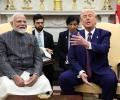
'Trump's aggressive stance towards China and preference for military posturing could shift the Quad's balance towards overt militarisation.'
India's forex reserves dropped by $5.681 billion to $561.267 billion for the week ended February 17, the RBI said on Friday. This is the third consecutive week of a drop in the reserves after the $8.319 billion decrease in the previous reporting week to $566.948 billion. In October 2021, the country's forex kitty had reached an all-time high of $645 billion.

India's forex reserves dropped by $8.32 billion to $566.95 billion for the week ended February 10, the RBI said on Friday. This is the second consecutive week of drop in the reserves after the $1.49-billion decrease in the previous reporting week. It can be noted that in October 2021, the country's forex kitty had reached an all-time high of $645 billion.

After rising for five consecutive weeks, India's forex kitty dropped $571 million to $563.5 billion for the week ended December 16, according to RBI data released on Friday. In the previous reporting week, the overall reserves had swelled $2.91 billion to $564.06 billion, making it the fifth straight week of an increase in the kitty after a protracted decline. In October 2021, the country's foreign exchange kitty had reached an all-time high of $645 billion.

Acutely conscious that he's left with less than four years to create his legacy, Trump is undoubtedly a man in a hurry, observes Ambassador M K Bhadrakumar.
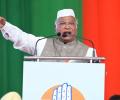
Congress president Mallikarjun Kharge has accused the BJP of rigging the Maharashtra assembly elections and called for a return to ballot paper voting. He also criticized the Modi government for selling off public assets, undermining democratic institutions, and promoting communal polarization. Kharge's remarks come as the Congress prepares for its AICC session in Ahmedabad, where it will present its political and economic views.
